Welcome to the website of Prof. David Opderbeck. I teach law at Seton Hall University Law School in New Jersey. In addition to my legal training, I’m trained as a theologian. At Seton Hall, I serve as Director of the Program on Faith, Values, and the Rule of Law and Co-Director of the Gibbons Institute of Law, Science & Technology and Institute for Privacy Protection. This page contains information about my legal scholarship, theological scholarship, books, and other materials.
Books
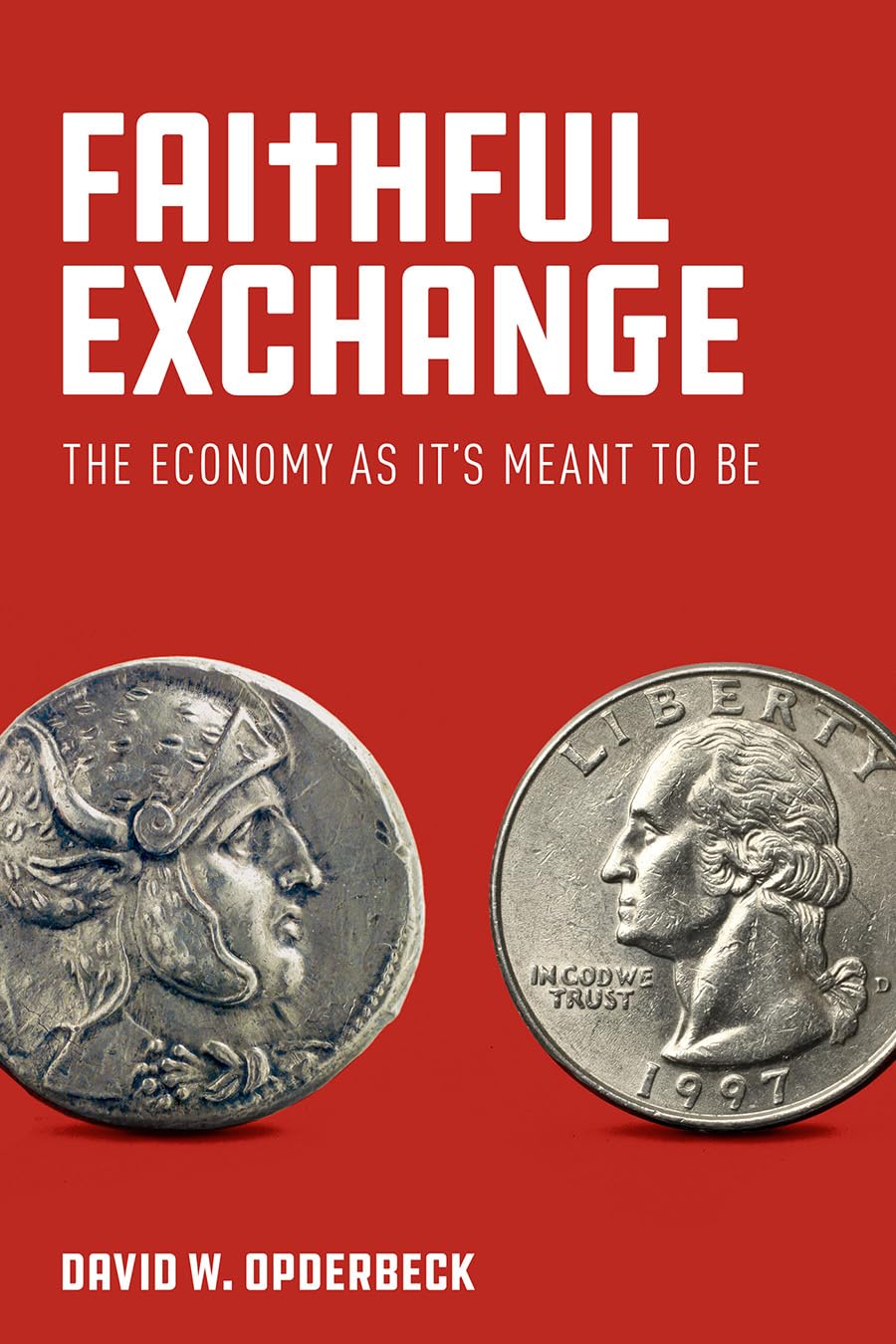
My third book, Faithful Exchange: The Economy As It’s Meant to Be, was published by Fortress Press in 2025. Here are some of the book’s endorsements:
“David Opderbeck offers a wide-ranging, critical, thoughtful reflection on the relentless tension between private property and the common good. After a judicious review of biblical resources, he addresses more contemporary concerns for a just economy in which the poor count in positive ways for the practice of the economy. Opderbeck affirms that the singular pursuit of private gain is deficient for an economy that is grounded in covenantal faith. This book is a major contribution to our critical, faithful thinking and merits close, sustained attention. Opderbeck boldly focuses on the interface between faith and money as an urgent issue among us.” –Walter Brueggemann, Columbia Theological Seminary
“Opderbeck’s Faithful Exchange is nothing short of a monumental achievement. Those who have studied and reflected on the relationship between theology and economics will find much here that is new, and those only beginning will find a superb introduction. The breadth of knowledge, its readability, and Opderbeck’s way of framing matters are truly exceptional. A close and comprehensive reading of Scripture, along with profound reflections on theology, ethics, and law, makes this one of the most important contributions in economic theology to date.” –Stephen Long, Southern Methodist University
“David Opderbeck combines a teacher’s eye for explanation with an outsider’s appetite for theology, a lawyer’s instinct for analysis and fine distinction, and a storyteller’s gift for ordered and engaging sequence. The result is an argument lucid in exposition, generous in vision, and informative in scope. No Christian reader could fail to be enriched by its portrayal of God’s economy, nor any economist come away from this text without an inspiring notion of the practical difference real Christianity makes. And as for a Christian economist: there are such people, and those who read this book will be moved to take their place among them.” –Samuel Wells, vicar, St Martin-in-the-Fields; Visiting Professor of Christian Ethics, King’s College London; and author of Constructing an Incarnational Theology: A Christocentric View of God’s Purpose
“Every economics–or at least every theology of economics–implies an eschatology. But, writes David Opderbeck, most economic theologies “fail to express a clear eschatological vision.” This remarkable book succeeds where so many have failed. Opderbeck argues with the clarity and acumen of a top-notch law professor and controls an immense range of biblical and theological data, like a first-rate theologian. Every time I read a book by Opderbeck I am stunned by its scope and learning, its reasoning and reasonableness, but I also walk away inspired and encouraged. More: this book gives me hope in a world where demand outstrips the supply.” –Brent A. Strawn, D. Moody Smith Distinguished Professor of Old Testament and professor of law, Duke University
“Faithful Exchange offers a constructive Christian theology of economics of astonishing breadth, skillfully weaving together a full range of texts from Hebrew and Christian Scriptures, themes and patterns from church history, and in-depth insights from law, political theory, and economics. Students who are less familiar with one or more of these areas have much to gain from the clear and accessible interdisciplinary weave. Experts in one or more of these fields will appreciate the careful and nuanced analysis that surfaces creative tensions and complexity. All will appreciate Opderbeck’s thoughtful call for discernment and prudence in the work of crafting contextually grounded proposals for moving toward “the economy as it’s meant to be.” –Amy Uelmen, lecturer in religion and professional life, and director for mission and ministry, Georgetown University Law Center
My second book, The End of the Law? Law, Theology, and Neuroscience, was published by Wipf & Stock / Cascade in 2021. Here are some of the book’s endorsements:
“This excellent book shows in a highly lucid fashion how contemporary neuro-scientism trades upon a notion of legality to which it has no right, in order to deny the very ground of the possibility of law, which is the law-making capacity of spiritual creatures that participates in the eternal law of God. No previous book has so successfully shown how scientific positivism trades on the incoherence of legal positivism much more than the other way round. It seriously illuminates the vicious biopolitics of our time and indicates the way beyond.”
–John Milbank, author of Theology and Social Theory
“Opderbeck’s is an argument of great originality and profundity. Modern attempts to reduce the human capacity for law and lawfulness–our capacity, that is, for transcending mere material necessity and evolutionary imperatives, as well as for failing before a standard at once within and beyond our nature–are ultimately as contradictory as all other forms of dogmatic naturalism. Opderbeck bracingly contends that this curious condition instead testifies to our relationship with and participation in a God of boundless love, and that its true and ‘natural’ explanation is found in Christology.”
–David Bentley Hart, author of The Experience of God: Being, Consciousness, Bliss
“If human moral agency is an illusion, perhaps law is merely a tool for the manipulation of human behavior. This is the perspective defended by reductionistic ‘neurolaw,’ drawing on recent developments in neuroscience. In this extraordinarily wide-ranging and vigorously argued book, legal theorist and theologian David Opderbeck shows how reductive neurolaw is self-defeating and how the emergentism and non-reductive physicalism embraced by many contemporary theologians continue to employ a problematically physicalist notion of causality. Building instead on the new Aristotelianism in the philosophy of science, with its non-reductive understanding of the relationship between brain states and human decisions, Opderbeck defends an approach that recovers formal and final causes, pointing unapologetically to love as the reason and end of creation, and to the law of love as a constituent element of human nature. Only if the order of creation flows from the order of love that is the law of God’s own being, he contends, is it possible to recover an adequately non-reductive account of how accountable human persons exist within the context of physical laws of nature. A vital contribution to an important cluster of debates.”
–Jennifer A. Herdt, Yale Divinity School
“One of the major concerns raised by recent neurolaw has to do with the legal consequences of skepticism about human agency raised by the neurosciences. This has important legal, philosophical, and theological implications. David Opderbeck is well placed to tackle these issues as both a lawyer and theologian. He has written an accessible and erudite study that tackles the historical dimension to the current debate as well as providing incisive criticism and a constructive theological response. This is an important interdisciplinary contribution to a pressing contemporary discussion with which lawyers, philosophers, and theologians working in this area will have to engage.”
–Oliver D. Crisp, University of St Andrews
“This is an erudite, closely reasoned, well-written, and wide-ranging study of the real and imagined problems for traditional Christian thought raised by the development of materialistic, biological, and now neurological theories about human nature and the possibility of an objective law to be discerned and obeyed by rational intelligences. Professor Opderbeck shows how a simply neurological account of our thoughts, motives and actions does more than contradict the Christian story: it is at odds with our ordinary self-understanding, with the possibility of a humane civil order, and with the scientific and scholarly enterprise itself: if all that we think, desire, and do is merely the effect of material events determined by the behavior of physical particles and the long effects of natural selection, there is no sense in supposing that we are capable of learning any objective truth, or amending our thoughts and actions in the light of an objective moral law. Only if we can in some way come to transcend our own physical nature can we hope even to learn what that nature is, and the Christian story at least offers a rational account of how that might occur. Scientists and theologians alike have a lot to learn from Professor Opderbeck.”
–Stephen R. L. Clark, University of Liverpool
“‘Follow the science’ is the saving message of pandemic times. And for good reason. But how do we follow the science while keeping our souls intact? Better yet, how do we follow science into goodness, truth, and beauty? Legal theorist and theologian David Opderbeck offers a way. Refusing the reductionist terms on offer, he presses toward a wonderfully bodied account of how our moral habits of speech, rather than flattening out as so much epiphenomenal noise, tell us about the sorts of creatures we are and the kind of world we live in. Especially useful is his Thomistic revision of neo-Aristotelian powers and properties to frame what evolutionary theory comes to regarding our most cherished commitments. Learned, sharp, disciplined, and absolutely needed.”
–Jonathan Tran, Baylor University
My first book, Law and Theology: Classic Questions and Contemporary Perspectives, was published by Fortress Press in 2019. Here are a few of the book’s endorsements:
“This volume offers an authoritative and accessible tour of natural law and positive law from the garden of Eden to the latest machinations of the United States Supreme Court. David W. Opderbeck brings both theological discernment and legal acumen to bear on the weightier matters of the law, on the quotidian questions of legal practice, and on the current cultural battles over sexual liberty and religious liberty. Judicious, candid, briskly paced, and cogently argued, this book deserves a wide readership.” –John Witte Jr., Emory University
“I know of no other book like this. Opderbeck develops a constructive theology of law that draws upon his deep knowledge of theology and the theory and practice of law. He offers substantive reflection on God’s being and attributes, superbly navigating the various controversies such reflection brings, for the purpose of constructing a theology of law that makes a significant contribution to moral and political theology. The breadth of knowledge is impressive. The masterful attempt to reconcile Christianity’s nonviolent ethics with law is a joy to observe. But this is only the first part of this splendid work. The second applies his theology of law in the US context, showing its relevance to the pharmaceutical industry, the lingering effects of slavery and racism, and much more. Opderbeck has set the standard by which all other attempts to address law theologically will be judged.” –D. Stephen Long, Cary M. Maguire University Professor of Ethics, Southern Methodist University
“Simultaneously lawyer, theologian, and law professor, David W. Opderbeck is a wise and expert guide into the fascinating nexus of theology and law. From Genesis to Revelation, Clement to Cone, natural law to positive law, Brown v. Board of Education to the Masterpiece Cakeshop case, usury to pharmaceutical product regulation, theory to praxis, Opderbeck covers immense ground and convincingly demonstrates along the way that a proper understanding of God’s mission can (and ought to) guide everything from how one lives and votes to how one litigates–even if one should–and why. The end is a vision of Christian life amid theology, law, and mission that is marked by patience and hope.” –Brent A. Strawn, Professor of Old Testament, Duke University, and Senior Fellow, Center for the Study of Law and Religion, Emory University
Legal Scholarship
My legal scholarship focuses on law and technology, including cybersecurity, artificial intelligence, and intellectual property. You can find links to many of my articles on my Legal Scholarship page. You can also find works in progress on my SSRN page.
Theological Scholarship
My theological scholarship focuses political theology, theology and science, and historical theology. You can find links to my papers and information about works in progress on my Theological Scholarship page.
Other Writing and Media
I keep a periodic blog and theology and culture, Through a Glass Darkly. I also maintain a site relating to law and technology, thecybersecuritylawyer.com. My YouTube channel includes video content related to some of my law school classes.